
Comment fixer le prix d'un contrat de service récurrent ?
Les revenus récurrents constituent l'atout le plus précieux qu'une entreprise de services puisse se constituer. C'est également ce qu'il y a de plus facile de mal tarifer pendant des années sans s'en rendre compte.
Mise à jour de l'7 septembre 2026
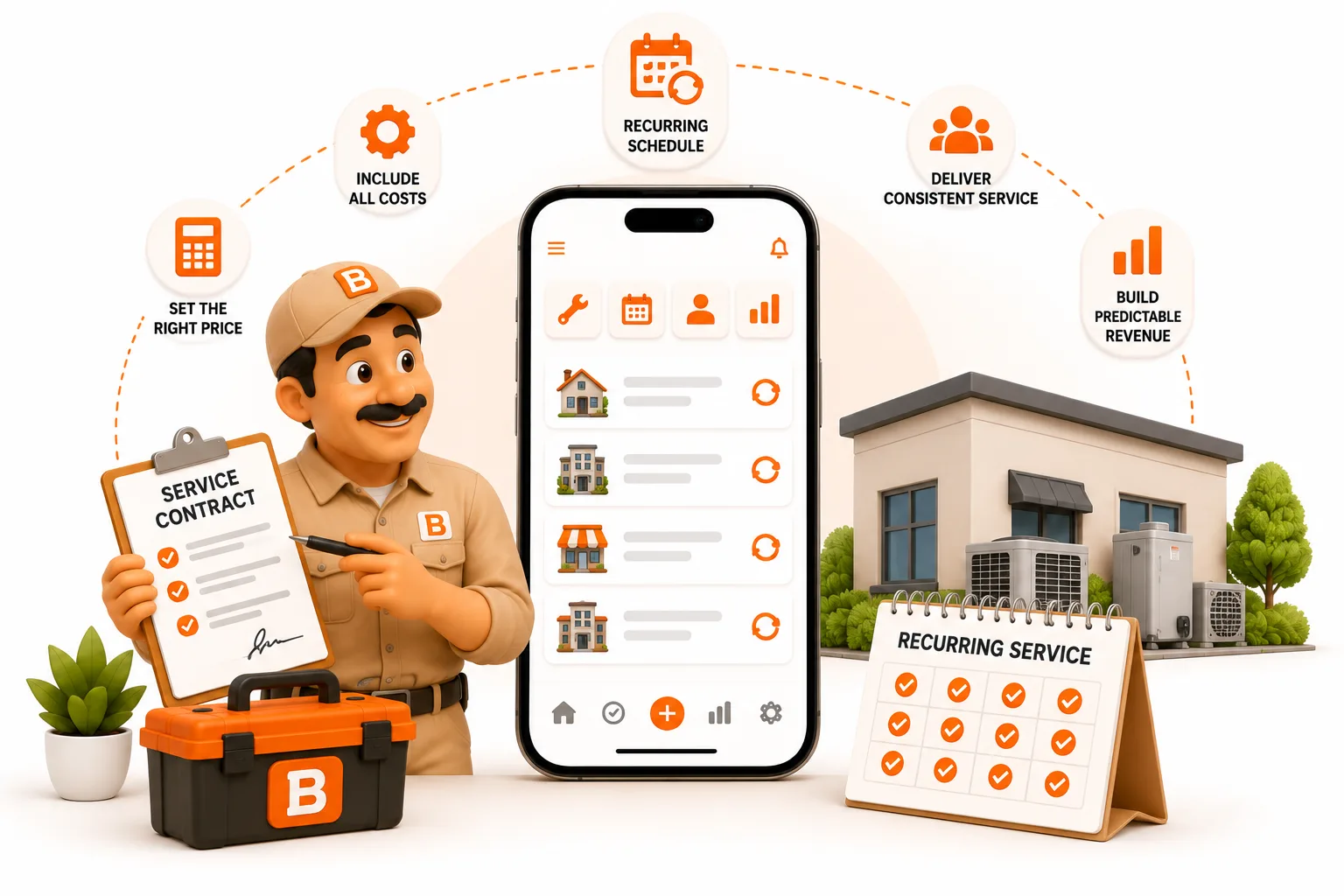
Les revenus récurrents constituent l’atout le plus précieux qu’une entreprise de services puisse se constituer. C’est aussi ce qu’il y a de plus facile de mal tarifer pendant des années sans s’en rendre compte.
Publié en septembre 2026.
La réponse en bref
Fixez le prix d’un contrat récurrent sur l’année, et non par intervention. Comptez chaque intervention sur une période complète de douze mois, y compris votre haute saison, totalisez les heures, appliquez votre taux horaire d’équilibre, ajoutez votre marge, puis divisez par douze pour obtenir une facturation mensuelle régulière. Deux éléments que la plupart des exploitants négligent : décider délibérément si la prévisibilité justifie une remise, et prévoir une augmentation annuelle afin que la troisième année ne soit pas facturée aux tarifs de la première.
Pourquoi il est important de bien faire les choses
Un travail récurrent a plus de valeur que le même chiffre d’affaires facturé mission par mission. Vous n’avez pas à reconquérir le client à chaque fois, le planning se remplit tout seul et la trésorerie ne subit plus les fluctuations saisonnières.
Les chiffres du secteur vont dans le même sens, même si la plupart proviennent de fournisseurs et de la presse spécialisée plutôt que d’études indépendantes ; il convient donc de les considérer comme indicatifs. Les prestataires indiquent généralement conserver chaque année entre 80 et 90 % de leurs clients sous contrat de maintenance, contre 40 à 60 % des clients pour des prestations ponctuelles ; par ailleurs, les entreprises dont une part importante du chiffre d’affaires est récurrente se vendraient à des multiples nettement plus élevés que celles fonctionnant uniquement à la demande.
La tendance ne fait pas débat : ce sont les revenus récurrents qui transforment une simple mission en une véritable activité. C’est précisément pour cette raison que sous-évaluer un contrat récurrent a des conséquences bien plus durables que de sous-évaluer une prestation ponctuelle. Une mauvaise prestation ponctuelle vous coûte un après-midi. Un mauvais contrat vous coûte chaque mois jusqu’à ce que quelqu’un le renégocie.
Le piège : accorder une remise pour avoir le « privilège » de s’enfermer soi-même
L’erreur la plus courante en matière de tarification des revenus récurrents semble généreuse et raisonnable : « Ils s’engagent auprès de moi pour toute l’année, je vais donc leur accorder une remise de 20 %. »
Regardez ce que vous venez de faire. Vous avez accepté un tarif plus bas et vous l’avez figé pour la durée la plus longue possible, alors que les coûts ne font qu’augmenter. Le client a obtenu une remise et une certitude. Vous avez obtenu une certitude et une baisse de salaire.
Il existe de réelles raisons pour lesquelles un tarif récurrent peut être légèrement inférieur à un tarif ponctuel : pas de vente répétée, des itinéraires prévisibles, un planning plus chargé, moins de devis non rémunérés. Ce sont de véritables économies, et elles ont généralement une valeur - mais elles valent ce qu’elles vous font réellement économiser, et non un chiffre rond que vous avez choisi pour paraître compétitif. Calculez les économies, puis répercutez-en une partie. Ne vous contentez pas d’estimer ce chiffre à 20 %.
Fixez le prix pour l’année, pas pour la visite
Voici la méthode complète, illustrée par l’exemple d’un contrat d’entretien paysager.
Étape 1 : Comptez le nombre réel de visites. Une fois par semaine pendant la saison de croissance, de mars à octobre, cela représente environ 32 visites. Une fois toutes les deux semaines de novembre à février, cela en ajoute 8. Cela fait 40 visites par an – et non « une fois par semaine », ce que vous auriez répondu spontanément, ni 52.
Étape 2 : Calculez le nombre total d’heures réelles. Disons 45 minutes sur place, plus 15 minutes de trajet et de chargement. Soit une heure par intervention, donc 40 heures par an. Prenez en compte le temps passé « de porte à porte », et non le temps passé à tondre.
Étape 3 : Appliquez votre taux de rentabilité. Si votre coût réel est de 74,80 $ par heure facturable (ce calcul figure dans « Comment ne plus sous-évaluer vos devis ? »), cela vous coûte 40 × 74,80 $ = 2 992 $ par an.
Étape 4 : Ajoutez une marge en divisant, et non en majorant. Avec une marge cible de 20 % : 2 992 $ / 0,80 = 3 740 $ par an.
Étape 5 : Divisez pour obtenir une facturation régulière. 3 740 $ / 12 = environ 312 $ par mois.
Maintenant, le plus important. En juillet, vous effectuerez peut-être cinq interventions pour ces 312 $. En janvier, vous n’en ferez que deux. Ce déséquilibre n’est pas un problème : c’est le principe même du métier. Le client achète une facture forfaitaire et prévisible ; vous, vous achetez un agenda bien rempli et un flux de trésorerie régulier. Mais cela ne fonctionne que si le prix est calculé à partir du total annuel. Si vous fixez le prix de la facture mensuelle en vous basant sur une semaine de juillet, vous serez dans le rouge dès le printemps.
C’est la dérive des objectifs qui, en réalité, réduit la marge
Dans le cadre d’une prestation ponctuelle, une demande du type « tant que vous êtes là, pourriez-vous juste… » ne vous coûte que vingt minutes une seule fois. Sur un compte récurrent, cela fait définitivement partie du service - et cela s’accumule, car le mois suivant, on s’y attend, et le mois d’après, il y en a une nouvelle.
Notez ce qui est inclus et ce qui ne l’est pas. Pas un document juridique, mais une liste claire dans le contrat : nombre de visites, ce que couvre chaque visite, ce qui est considéré comme un supplément et, approximativement, le coût de ces suppléments. La discussion que vous voulez éviter, c’est celle qui survient au bout de deux ans, lorsque vous finissez par refuser quelque chose que le client considère comme standard depuis le troisième mois.
Un test utile : si un autre technicien prenait en charge ce compte demain, pourrait-il déterminer, à partir des documents, ce qui est inclus ? Si ce n’est pas le cas, le périmètre n’est pas défini : il repose uniquement sur votre mémoire.
Prévoyez dès maintenant l’augmentation annuelle
C’est la clause la plus importante d’un contrat récurrent, et la plupart des petits prestataires ne l’ont pas prévue.
Vos salaires, votre carburant, vos assurances et vos matériaux augmentent tous chaque année. Si le contrat n’augmente pas en conséquence, votre marge s’érode discrètement, et dès la troisième année, vous effectuez le travail à perte. Vous vous retrouvez alors confronté à la pire conversation qui soit : demander une hausse de 25 % d’un seul coup, ce qui semble scandaleux à un client même s’il s’agit simplement de rattraper trois ans de retard.
Au lieu de cela, précisez-le d’emblée : les prix augmentent d’un pourcentage fixe chaque année à la date anniversaire du contrat, ou suivent un indice publié. Mieux vaut une augmentation modeste et prévisible qu’une hausse importante et brutale. Les clients acceptent beaucoup plus facilement une légère hausse annuelle qu’une correction soudaine – et vous n’avez jamais à vous armer de courage, car cela figure déjà dans le contrat.
Quelques autres éléments à prendre en compte dans la tarification
- Le taux de résiliation. Un contrat dont le prix a été fixé sur la base d’une durée de trois ans et qui prend fin au bout de huit mois ne permettra jamais de rentabiliser les efforts engagés pour le décrocher. Ayez une idée approximative de la durée réelle de vos contrats.
- Le coût réel de la haute saison. Si la haute saison implique des heures supplémentaires ou le recours à un intérimaire, ce coût doit être pris en compte dans le total annuel.
- Les rappels et les appels entre deux visites. Les clients réguliers appellent davantage. C’est généralement une bonne chose, mais cela a un coût.
- Conditions de paiement. La facturation mensuelle ne garantit une trésorerie fluide que si les paiements sont effectivement effectués chaque mois.
En quoi un registre des interventions est utile
Chaque étape ci-dessus nécessite une information dont vous ne disposez peut-être pas : le temps réellement consacré à chaque intervention.
Dans ToolBerry, les visites récurrentes sont planifiées selon leur cadence réelle ; vous pouvez donc consulter le nombre de visites pour l’année au lieu de l’estimer. Les bons de travail consignent le détail de chaque intervention, avec des notes et des photos, et vous pouvez ajouter des champs personnalisés pour le temps réel passé, de sorte que les durées effectives d’une saison s’accumulent sur le compte. Au moment du renouvellement, vous fixez vos tarifs en fonction de ce qui a réellement été effectué plutôt que de ce dont vous vous souvenez. Cet outil est gratuit et fonctionne hors ligne, ce qui permet de remplir le registre directement sur place.
En revanche, cet outil ne calcule pas vos frais généraux, ne rédige pas votre contrat et ne suit pas les conditions contractuelles ni les dates de renouvellement comme le ferait un système de gestion des contrats formel. Ces éléments relèvent de votre comptabilité et de votre administration.
Les mises en garde honnêtes
Nous sommes des ingénieurs, pas des comptables ni des avocats. Les chiffres présentés ici sont donnés à titre indicatif : ils illustrent le principe mathématique, pas vos chiffres réels. Les clauses d’indexation, les conditions de résiliation et les obligations auxquelles un contrat de service peut lier un client varient d’un État à l’autre et méritent d’être examinées par un professionnel avant que vous ne standardisiez un contrat que vous signerez des dizaines de fois.
Réévaluez d’abord les nouveaux contrats. Fixez immédiatement les tarifs des nouveaux contrats ; modifiez ceux des contrats existants lors de leur renouvellement. Réévaluer tous les contrats en même temps, c’est le meilleur moyen de perdre en un mois l’équivalent d’une saison de chiffre d’affaires.
Vous avez une question ?
Nous avons développé ToolBerry en tant qu’ingénieurs en activité, et les missions récurrentes constituent la colonne vertébrale de la plupart des entreprises avec lesquelles nous échangeons. Si vous effectuez vos calculs annuels et que les résultats vous surprennent, n’hésitez pas à nous en faire part : contact@toolberry.net.
Téléchargez ToolBerry sur l’App Store ou Google Play, ou rendez-vous sur toolberry.net.
Gratuit à vie pour les travailleurs indépendants. Pas de compte. Pas de carte bancaire. Fonctionne hors ligne.
À lire également
- Comment éviter de sous-évaluer vos devis ? – le seuil de rentabilité sur lequel repose cette méthode
- Comment ToolBerry aide les paysagistes à gérer leur activité – itinéraires récurrents, un métier à la fois
- Lutte antiparasitaire : services récurrents et registres de terrain sans papier – un autre secteur où les interventions récurrentes sont nombreuses
- Suivi des chantiers clients et du matériel pour ne plus avoir à deviner lors de la prochaine visite – l’historique qui facilite la tarification des renouvellements