
What to Include in a Residential Plumbing Maintenance Plan
A vague plan leads to arguments later. Define what you check, how often you visit and what costs extra, so customers know what they’re paying.
Aggiornato28 ottobre 2026
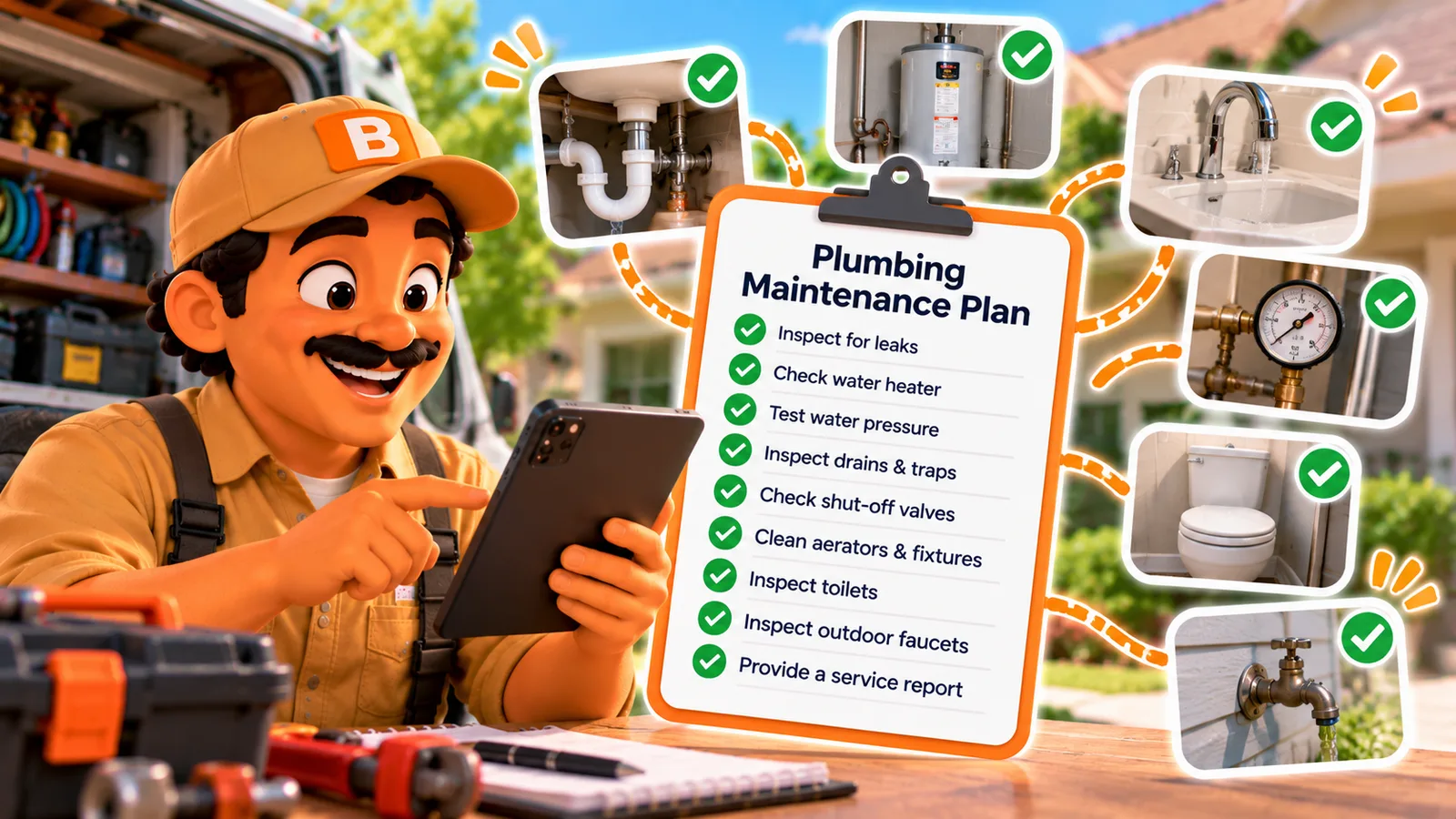
A vague plan leads to arguments later. Define what you check, how often you visit and what costs extra, so customers know what they’re paying.
You’ll leave with a plan you can write up and send: services, visit schedule, exclusions and a way to log each visit.
A customer asks what they get with your maintenance plan. You say “a full checkup.” Now they think every leak, clog and worn part is covered. That gap is where complaints start.
The short answer: A residential plumbing maintenance plan should list the specific checks you do (visible leaks, faucets, toilets, drains and any equipment you service), how many visits the customer gets, and what costs extra, like repairs and parts. Name each task, and say what happens when you find a problem.
What should a plumbing maintenance plan cover?
A plumbing maintenance plan should cover preventive checks on the parts of the plumbing you can reach and the equipment you service. Maintenance looks for problems early. A repair fixes one. The plan should say where checking ends and fixing begins.
Here’s the difference in practice. Checking a connection for a leak can be included in the plan. Repairing that leak or replacing a part can have its own price.
Build the plan around what your business can actually deliver and what the home actually has. Don’t promise that maintenance prevents every failure or covers every emergency.
Which plumbing services can you include in a maintenance plan?
Most plans draw from four categories: visible leaks at accessible connections, faucets and toilets, drain performance, and equipment like a water heater. For each one, decide what you check and what task, if any, you’ll perform. Checking and fixing are separate promises.
- Visible leaks: Look at accessible connections, like those under sinks and at fixtures, for moisture or drips. Possible task: report what you found and quote the repair.
- Faucets and toilets: Run them and look for drips, constant running or loose handles. Possible task: small adjustments, if you choose to include them.
- Drains: Check that sinks, tubs and showers drain the way they should. Checking a drain doesn’t automatically include clearing it. Decide, then write it down.
- Water heater or other equipment: Tasks depend on the model, its condition and the manufacturer’s recommendations. List only equipment you service, and follow the manual for that unit.
This isn’t a universal technical list. It’s a set of criteria so you can define your own service.
Pro tip: Name the concrete task. “Visible leak check at accessible connections” is easier to understand than “complete maintenance.”
How often should you visit, and what should cost extra?
Set visit frequency based on the age and condition of the plumbing, the equipment in the home and the property’s history of problems. An older home with a repeat issue may need more visits than a newer one with none. State how many visits the plan includes and how you bill extra ones.
Two homes on the same plan can need very different attention, so skip the one-size-fits-all calendar. Put the number of visits in the plan, and tell customers up front how an extra visit is billed.
Next, say what the plan doesn’t cover. Customers tend to assume “maintenance” covers more than it does. These usually sit outside it:
- Repairs
- Parts and replacements
- Any work your business doesn’t do
Perks need the same clarity. If you offer a discount or priority scheduling, explain what it means and when it applies. “Priority” means nothing until you define it.
How do you build an included services checklist?
An included services checklist lays out four columns side by side: the service, whether it’s included, how often you do it and what costs extra. It lets the customer see the offer at a glance. It also lets you see your own plan clearly.
Here’s a simple fictional plan with two visits a year. It’s an example to adapt, not a schedule for every home.
| Service | Included? | Frequency | Costs extra |
|---|---|---|---|
| Visible leak check at accessible connections | Yes | Both visits | Leak repair, replacement parts |
| Faucet and toilet check | Yes | Both visits | Replacing worn parts |
| Drain performance check | Yes | Both visits | Drain clearing |
| Water heater check (only if you service that model) | Yes | Once a year | Repairs, parts, tasks outside your service |
| Summary of findings sent to the customer | Yes | Both visits | Nothing |
Treat every row as an option. Delete what you don’t offer and add what you do.
How do you explain the plan to the customer?
Explain the plan in plain words before the first visit: what each visit includes, what happens if you find a problem, and whether emergencies are covered. A customer who knows where the plan stops won’t be surprised when a repair comes with its own quote.
Here’s a message you can adapt:
“Here’s what the plan covers. At each visit I check [services]. If I find a problem, I’ll show you what I found and send you a separate quote before doing any repair. Emergency calls [are / are not] covered by the plan: [one line on how they work]. After every visit you’ll get a short summary of what I checked and what I found.”
How do you keep a record of every maintenance visit?
Keep a record of every home on a plan, especially your regular customers. Months can go by between visits, and it’s easy to forget which faucet dripped or which part you flagged. An app like ToolBerry keeps it all on your phone: notes, photos, and the full history of every visit to that property.
- What you checked
- What you found, with photos
- What you recommended
- When the next service is due
That record is what makes the next visit useful. Say you find a worn part and the customer decides to wait on the repair. Before the next visit, you open the property, see the note and the photo, and bring it up with the facts in hand. When you close each visit, share the job report PDF as the customer’s summary.
Quick answers
How do you price a plumbing maintenance plan?
Start with what each visit costs you: your time, travel, and any materials you include. Multiply that by the number of visits in the plan, then add your margin on top. Finally, check the total against what your customers would reasonably pay. There’s no single formula, so use your own rates.
Should you offer the plan to every customer?
Not necessarily. A plan works best where you can reach the fixtures and equipment you’ll be checking. If a home has equipment you don’t service, leave it out of the plan and say so.
Where should you keep notes on each customer’s home?
Keep them on the property in a job app, not in a notebook or your phone’s notes, where they drift away from the job. ToolBerry keeps the main shutoff location, cleanout access, lockbox codes and job history on each property. On the free app your data stays on your device. It works offline, and it’s free with no account and no ads. Even if you haven’t been to a house in months, you open the property and know how you left it.
The example plan is fictional. Maintenance tasks depend on the equipment, local requirements and manufacturer recommendations, so confirm them for each home you serve.
Have a question?
Want a second opinion on your maintenance plan? Email us at contact@toolberry.net.
Grab ToolBerry from the App Store or Google Play, or visit toolberry.net.
Further reading
- How to Add Your Plumbing Crew to ToolBerry, Step by Step - Set up your helpers’ phones and your own tablet in one evening, screen by screen.
- Making ToolBerry Yours for Plumbing: Trade, Fields and Language - Pick your trade, rename things and add custom fields, and change the app’s language.
- Job Photos, Receipts and Signatures, Stored in Your Own Dropbox - Where your visit photos and records live once you take them.