
What to Ask Before Quoting a Lawn Mowing Job
A vague quote request leads to a wrong price. Here’s what to ask, which photos to request and what to confirm first.
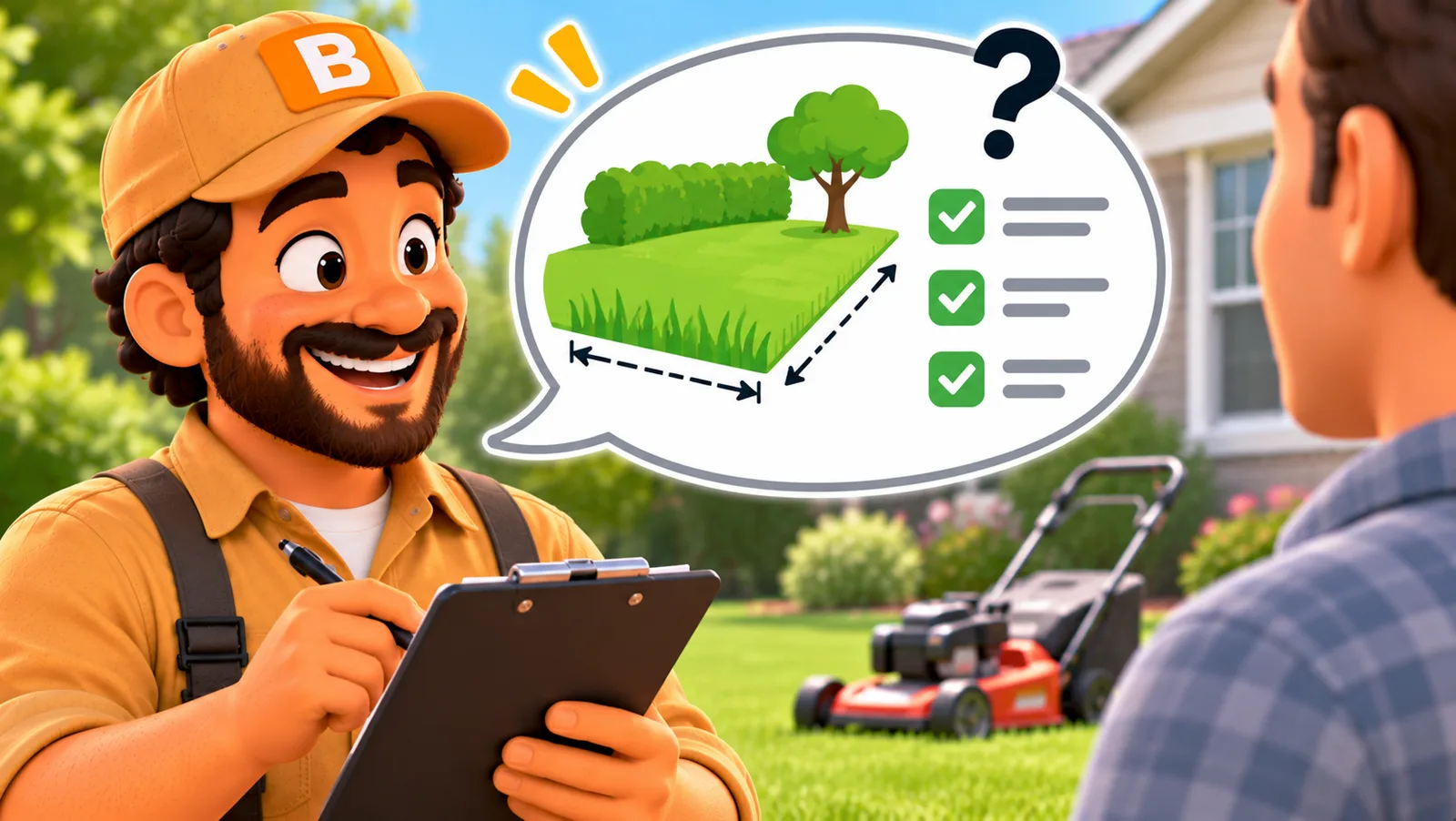
A vague quote request leads to a wrong price. Here’s what to ask, which photos to request and what to confirm first.
Copy-and-paste messages for the questions, the photos and the confirmation, plus a worked example.
A text comes in while you’re edging someone else’s yard: “Hey, how much to mow my lawn?” No address, no size, no photo. Answer with a number and you’re guessing. Answer with ten questions and they might text the next guy.
The short answer: Before you quote a lawn mowing job, get the address, how often they want it cut, when it was last mowed, and anything that slows you down, like slopes, a narrow gate, a dog or a lot of flower beds. Ask for a few photos. Then confirm the start date, rain days and any first-cut charge in writing before you lock in the price.
What should you ask before quoting a lawn mowing job?
Before quoting a lawn mowing job, ask five things: the address, how often they want it mowed, when it was last cut, what’s in the way (slopes, gates, a dog, beds and trees), and what they want done with clippings and edges. Send it all in one message so the customer answers once.
Hi [name], thanks for reaching out! To give you an exact price, can you tell me:
- Your address
- How often you’d like it mowed (weekly, every 2 weeks or one-time)
- When it was last cut
- Anything I should know about: slopes, a narrow gate, a dog, lots of trees or flower beds
- Should I bag the clippings, and do you want edging?
A couple of photos of the front and back yard would help too.
Don’t ask how big the lawn is. Most customers don’t know, and the ones who guess usually give you the lot size. With the address, you can pull up a satellite view and measure the grass yourself.
Which answers change the price the most?
The answers that change a lawn mowing price the most are how much of the yard is actually grass, how long it’s been since the last cut, and how often you’ll come back. Obstacles and access come next, because they add minutes that the square footage doesn’t show.
| Question | Why it matters | What to do with the answer |
| How much of the lot is grass? | You don’t mow the house, driveway or beds | Measure the turf on a satellite map, not the lot |
| When was it last cut? | Tall grass is slower and may need two passes | Add an overgrown charge to the first visit |
| How often? | Longer gaps mean taller grass every visit | Price every 2 weeks and monthly higher per visit than weekly |
| Slopes, trees, beds, play sets? | More trimming, slower mowing | Raise the price for that property and note why |
| How wide is the gate? | Your mower might not fit | Get a photo before you show up with the wrong mower |
| Is there a dog? | Safety, a locked gate, a messy yard | Agree on when the dog stays inside |
| Clippings and edging? | Bagging and edging take extra time | Quote each one as its own line |
What photos should you ask the customer to send?
Ask the customer for four or five photos: the whole front yard, the whole back yard, the gate you’ll come through, the tallest grass with a shoe next to it for scale, and any slope or obstacle they mentioned. Photos answer the questions a customer can’t describe well in a text.
Thanks! Could you send me a few quick photos?
- The whole front yard
- The whole back yard
- The gate I’d come through
- The tallest grass, with your shoe next to it
Phone photos are perfect.
Photos are enough for a small, flat lawn. If the yard is big, hard to see from above, hasn’t been cut in a while, or has a pool, a steep slope or a lot of beds, go walk it before you commit to a price for the whole season.
What should you confirm before you lock in the price?
Before you lock in a lawn mowing price, confirm in writing the start date, that the price is per visit, how often you’ll come, what happens on rain days, whether the first cut costs extra, how you get in and how they’ll pay.
Here’s what we agreed: $[price] per visit, [weekly / every 2 weeks], starting [date]. The first cut is $[first-cut price] because the grass is tall. If it rains, I’ll come the next dry day. Gate code is [code], and the dog stays inside on [day]. You can pay by [method]. Sound good?
A “Sound good?” reply in writing is worth more than a handshake you both remember differently.
How do you turn the answers into a quote?
You turn the answers into a lawn mowing quote by pricing the grass area at your rate, adjusting for how often you’ll come, and adding extras as separate lines. Here’s an example using the default rates on ToolBerry’s free lawn mowing calculator (which are US averages).
The customer has about 1/4 acre of grass, wants it mowed weekly, and says it was last cut a month ago.
| Line | How it’s figured | Price |
| Weekly mowing, 1/4 acre of grass | 10,890 sq ft ÷ 1,000 x $4.50 | $49 per visit |
| Overgrown charge, first visit only | Flat extra | $40 |
| First visit | $49 + $40 | $89 |
| Monthly after that | About 4.33 visits x $49 | About $212 |
You can get those numbers in a few seconds with the lawn mowing calculator. Enter the lawn size, how often you’ll mow and the extras, set your own rates, and tap “Make this an estimate” to turn it into a quote. Then keep the customer in ToolBerry, free with no sign-up needed. Save the property with the address, the gate code and a note like “dog inside on Tuesdays,” and add the customer’s photos to the job, so next season you don’t have to ask again.
Quick answers
What if the lawn doesn’t match the photos when you show up?
Say so before you start, not after. Show the customer what’s different, give them the new price and let them decide. A line in your confirmation like “price based on the photos you sent” makes that conversation a lot easier.
Should you charge for coming out to quote?
A free quote is easier to say yes to. If a property is far off your route or needs a long walkthrough, it’s fair to charge for the visit and take it off the first invoice if they book.
Prices in this article are the calculator’s default US averages, used as an illustration. Set your own rates for your area.
Have a question? Email us at contact@toolberry.net.
Get ToolBerry on the App Store or Google Play.
Further reading:
- How to Stop Underpricing Your Estimates?: the math behind your rate
- How Do You Offer Good, Better, Best Options on a Quote?: give the customer options instead of one price
- ToolBerry for landscaping: how lawn and landscape pros run their jobs from a phone