
What to Say When a House Cleaning Client Asks for a Discount
A client wants a lower price. Here’s how to answer by text without cutting your rate or losing the house.
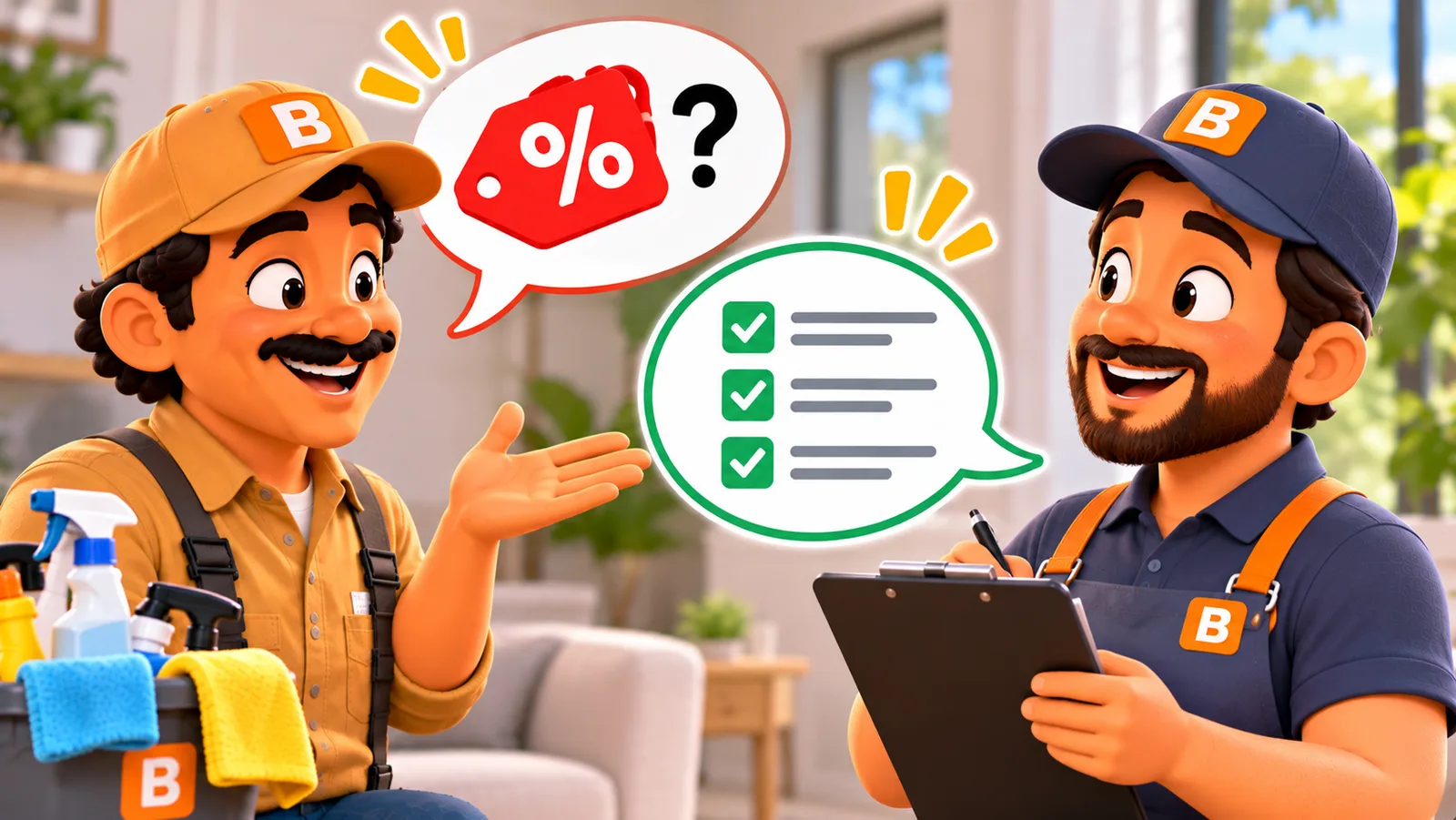
A client wants a lower price. Here’s how to answer by text without cutting your rate or losing the house.
Three kinds of discount requests, replies you can copy, and a worked example for trimming the job instead of your price.
Published November 2026.
You’re in the car between houses when the text comes in: “Love your work! Any chance you could do it for $160 instead of $260?” You want the job. You also know $160 doesn’t cover what that house takes.
The short answer: When a house cleaning client asks for a discount, first figure out what they’re really asking. A fair question about price gets a straight answer. A comparison with another cleaner gets an answer about what your clean includes. A lowball gets a polite no. And if you want to meet a client’s budget, change the job, not your rate.
Should you give a discount when a cleaning client asks for one?
A house cleaning discount makes sense when it’s a decision you made in advance, like a lower rate for clients on a weekly or biweekly schedule. A discount you give because someone pushed is different. It tells the client your price was an opening bid, and they’ll push again next time.
Before you reply, ask yourself one question: would I give this price to anyone who booked this same clean? If yes, offer it. If not, keep your price and look at the job instead.
How do you tell a fair discount request from a lowball?
A fair discount request asks about your price. A comparison points to someone cheaper. A lowball names a number that doesn’t cover the work. Cleaning clients usually send one of these three, and each one needs a different reply.
| Type | What it sounds like | How to answer |
| Fair request | “Is it less if we book every other week?” or “What if you skip the windows?” | Answer it straight. It’s a normal question. |
| Comparison | “Our last cleaner charged $90.” | Explain what your clean includes. |
| Lowball | “Can you do the whole house for $60 cash?” | Restate your price once, politely, and leave the offer open. |
The first type isn’t negotiation you need to win. Answer it the way you’d answer “Do you bring your own supplies?”
What do you say when a client says another cleaner charges less?
When a client says another cleaner charges less, answer with what your clean includes instead of defending the number. The client is comparing two prices without knowing whether the two cleans are the same job. Your reply should make the difference easy to see in a couple of sentences.
Hi [name], totally fair to compare. My price for your home is $[price], and that covers [what’s included, e.g. kitchen, 2 bathrooms, all floors, inside the microwave]. [One thing that sets you apart, e.g. I bring all my own supplies.] If that works for you, I can come [day].
Leave out how much your supplies cost or what you pay for gas. The client doesn’t need your budget, just a clear picture of what they’re getting.
How do you answer an offer that’s way below your price?
Answer a lowball offer by thanking the client, restating your price once, and leaving the door open. Don’t counter with a number in between, because that tells them your first price wasn’t real. A short, friendly reply is usually enough, and you don’t owe anyone a breakdown of your costs.
Thanks for getting back to me, [name]. I can’t do the full clean for $[their offer], but my price of $[your price] stands. If you’d like a smaller visit that fits your budget, I’m happy to put one together.
If they keep pushing after that, one last message closes it:
I understand. My price for your home is $[your price]. If anything changes, I’d be glad to help.
Paste their text into ToolBerry’s Lowball-o-Meter, pick House cleaning, and you get a lowball score, the tactics the client is using, and three polite replies that hold your price. Free, no sign-up needed. The replies are starting points to adjust so they sound like you, the message is sent to an AI provider to be scored (it isn’t stored, but leave out anything private), and the tool won’t tell you what to charge in the first place.
How can you lower the price without lowering your rate?
You lower the price of a house cleaning without lowering your rate by changing the job: fewer rooms, fewer extras, or a lighter clean. Your hourly rate stays the same, the client gets a number they can say yes to, and your next quote doesn’t start weaker.
Things you can take out or change:
- Switch from a deep clean to a standard clean
- Drop add-ons like inside the oven, inside the fridge or interior windows
- Skip rooms the client doesn’t use, like a guest room
- Move them to your recurring rate if they book a regular schedule
Here’s how that works with the $260 quote from the opening, at $40 an hour:
| Original quote | Adjusted quote | |
| Clean | Deep clean, 4.5 hours ($180) | Standard clean, 3.5 hours ($140) |
| Inside oven | 0.5 hours ($20) | 0.5 hours ($20) |
| Inside fridge | 0.5 hours ($20) | Not included |
| Interior windows | 1 hour ($40) | Not included |
| Total | 6.5 hours x $40 = $260 | 4 hours x $40 = $160 |
The client gets their $160. You still earn $40 an hour, and the deep clean stays on the table for later.
Before you reply
☐ Decide which kind of request it is: a question, a comparison or a lowball
☐ Check your price for this house before you answer
☐ Pick what you could take out of the job, if anything
☐ Keep the reply to two or three sentences
Quick answers
Should you put your prices in writing before a client asks for a discount?
Yes. A written quote that lists what’s included shows the client exactly what the price covers. When they ask for less, the conversation turns into what to take out instead of how much you’ll drop.
What if a long-time client asks for a discount?
A long-time client who asks for a discount is often dealing with a budget change, not testing you. Ask what changed. If you want to thank them for their loyalty, an occasional free add-on costs you less than a lower rate on every visit.
Numbers in this article are illustrative. Use your own rates and the time each house actually takes.
Have a question? Email us at contact@toolberry.net.
Get ToolBerry on the App Store or Google Play.
Further reading:
- House cleaning price calculator: price a clean from square footage, rooms and add-ons
- ToolBerry for cleaning businesses: how cleaners run their jobs from a phone