
SAP Makes You Pay to Stay and Pay to Leave. Why Service Businesses Should Move to ToolBerry
SAP is forcing thousands of companies into a migration they did not ask for, charging them to use their own data, and billing them every year while they wait.…
Updated September 23, 2026
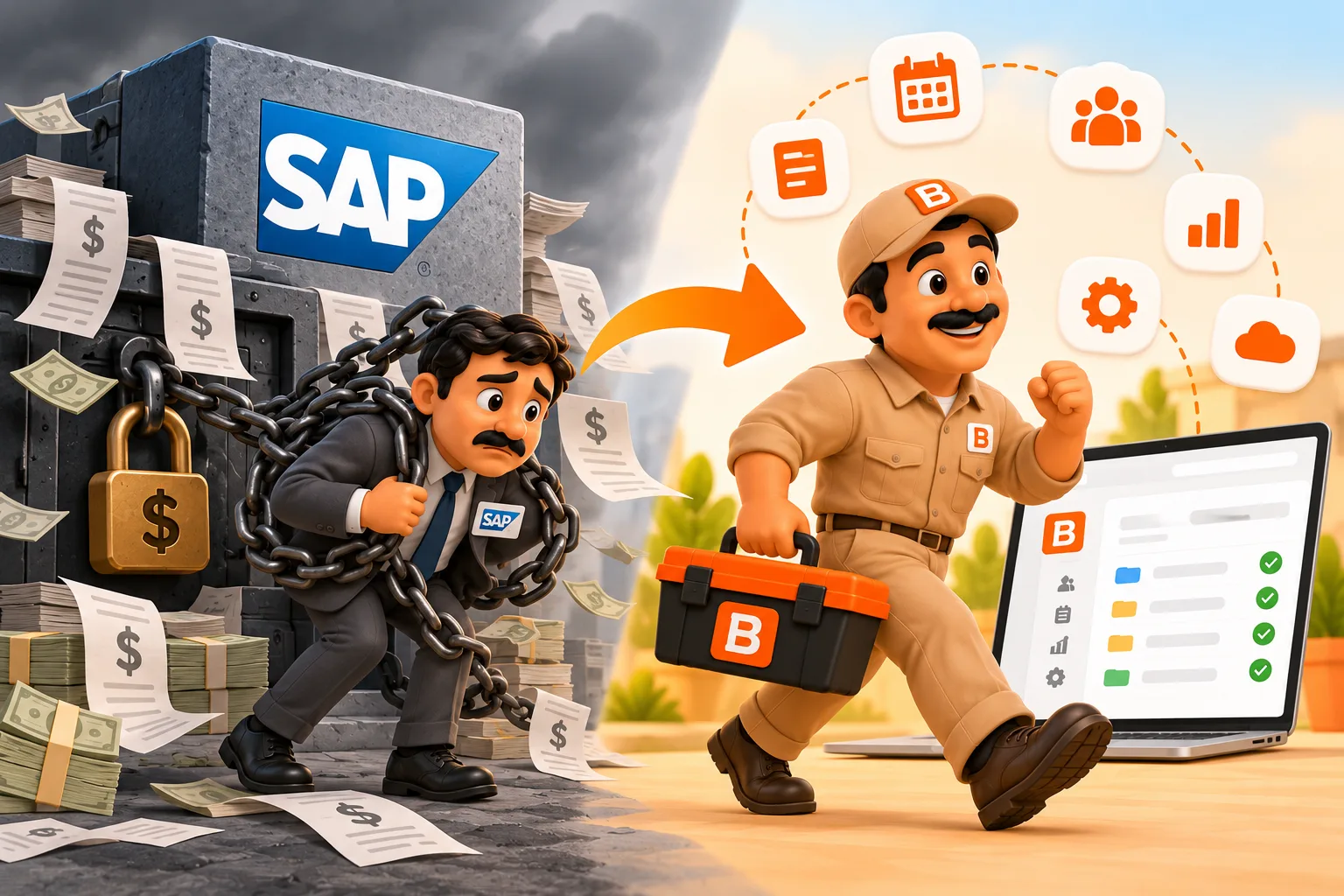
SAP is forcing thousands of companies into a migration they did not ask for, charging them to use their own data, and billing them every year while they wait. If you run a service business on SAP, or someone is trying to sell it to you, this is a good moment to look at a simpler way.
How SAP treats its customers, and what running your field work on ToolBerry looks like instead. Published September 2026.
SAP decides when you move, not you
For about 20 years most SAP customers ran a system called ECC. Now SAP wants everybody on its new system, S/4HANA, and it set the date for them. Standard support for the common ECC versions ends on December 31, 2027. After that you can keep going for a few more years, but you pay extra for it.
So the customer does not choose if they want to upgrade. The only choice is: pay for the migration now, pay more to wait, or pay to leave. For large companies these projects cost tens or hundreds of millions of dollars. And many of them did not start yet, because they know how painful it is.
When a software company can put a deadline on your business and make you pay for it, you are not the customer anymore. You are the one being managed.
SAP charged companies for using their own data
This is the part that shows how SAP thinks about its customers.
Some companies connected other tools to their SAP data, for example a sales app or an ordering system. SAP said that was "indirect access" and asked for more license money.
- SAP took Diageo, the company behind Johnnie Walker and Guinness, to court in the UK and won in 2017. SAP claimed about 54 million pounds.
- SAP went after AB InBev, the beer company, for a claim that could have passed 600 million dollars. AB InBev settled.
It was the customer's data. They typed it, they paid to store it, and they still had to pay again to let another tool read it. SAP changed its licensing rules later, but that tells you what the relationship looks like.
The bill never stops
With SAP you pay for the license, then every year you pay for maintenance, usually around a fifth of the license value. Then you pay consultants to install it, customize it, and fix it. Many of them charge by the hour or by the day, so a longer project is more money for them, not less.
Now, for the new migration, SAP asks customers to remove years of customizations. The same customizations that SAP and its partners sold them in the first place. And a lot of that work moves to another paid SAP platform.
When it goes wrong, the customer pays
These are real companies, and real money:
- Lidl cancelled its SAP project after about 7 years and around 500 million euros.
- Revlon went live on SAP in 2018 and could not ship about 64 million dollars of orders. Then the shareholders sued.
- Zimmer Biomet sued Deloitte for 172 million dollars after its S/4HANA go-live, after paying the consultants about 94 million.
- Halliburton reported 112 million dollars of S/4HANA costs in the first nine months of 2025 alone.
None of these companies wanted to be in the news for their software. They just wanted to run their business.
And this is how SAP talks about its own people
In September 2025, SAP's CFO told the German newspaper Handelsblatt that cutting jobs every year is "like brushing your teeth." Routine. Nothing special.
If a company talks like that about its own employees, think about how much your small account matters to them.
A service business does not need any of this
SAP was built for giant companies with finance departments, IT teams and consultants on retainer. Even SAP's own field service product is aimed at operations with 100 or more technicians and a dedicated IT team.
A landscaping company, an HVAC shop, a power services company or a cleaning crew needs something else. You need to schedule jobs, send the crew, fill the checklist, take photos, send the invoice and get paid. You need your team to use it on the phone in the field, on the first day, without a consultant.
That is what ToolBerry does.
What moving to ToolBerry looks like
No forced migrations. ToolBerry is one app from one person to many crews. You do not move to a different product when you grow. You add ToolBerry Pro and keep the same app your crew already knows.
Your data is yours. You can export your data any time. Nobody charges you to look at your own customer list.
No lock-in. ToolBerry Pro has no auto renewal and no termination fee. If you stay, it is because it works for you.
Priced per company, not per technician. Hire your next tech and your bill stays the same. Compare that with a license model where every new user is a new cost.
Ready for your trade on day one. ToolBerry comes with templates for 10 industries, including landscaping, HVAC, electrical, plumbing, pest control and power services, with real job checklists and equipment models already inside. You start from a working setup, not from a blank screen and a consulting contract.
Built for the field. Native apps for iPhone and Android, offline-first so the crew keeps working with no signal, and card payments through your own Stripe account.
Built for a team that grows. Roles and permissions, a full change history on every record, timesheets with approvals, recurring maintenance agreements, job costing and custom reports.
You can see where it is going. Our roadmap is public. You can see what is shipped, what is in progress and what is planned, like QuickBooks integration and more import options. No surprise end-of-life dates.
How to start this week
- Download the free app and pick your industry template.
- Bring your customer list over with CSV import. Names, emails, phones and custom fields come across.
- Run a few real jobs with one crew next to your current system.
- When the crew is happy, move the rest of the team to ToolBerry Pro.
You do not need a 3-year project plan for this. You need one crew and one week.
Have a question?
If your company runs on SAP today and you want to talk about moving your field work to ToolBerry, email us at contact@toolberry.net. We are happy to look at your setup with you.
Grab ToolBerry from the App Store or Google Play, or visit toolberry.net.
Further reading
- Is ToolBerry Only for Small Businesses? One App, From Solo to Multi-Crew - growing without changing systems
- CSV Import: Can You Move Your Customers from Jobber or Excel into ToolBerry? - bringing your customer list over
- One App, Ten Industries, Infinite Possibilities - the industry templates
- What's on the ToolBerry Roadmap, and How You Can Help Shape It - see what is coming before you decide