
No Cheese in the Trap: The Rule Behind ToolBerry Free
I want to give it away. I just can't afford to pay for it. Everything about ToolBerry Free comes out of holding those two things at once.
I want to give it away. I just can't afford to pay for it. Everything about ToolBerry Free comes out of holding those two things at once.
A note from our founder. Published September 2026.
The rule
There's one rule behind every decision about what lands in ToolBerry Free and what sits in Pro:
If we can build it so that it costs us essentially nothing as we grow, it's free, no matter how valuable it is. If it costs us real money for every user who touches it, it belongs in Pro.
That's the whole line. Not "how much is this worth to you." Not "what would people pay." Just: what does this cost us at scale, and is there a way to make that number zero?
It sounds simple. In practice it's the hardest engineering constraint we work under, and it's the reason ToolBerry looks different from other field service software.
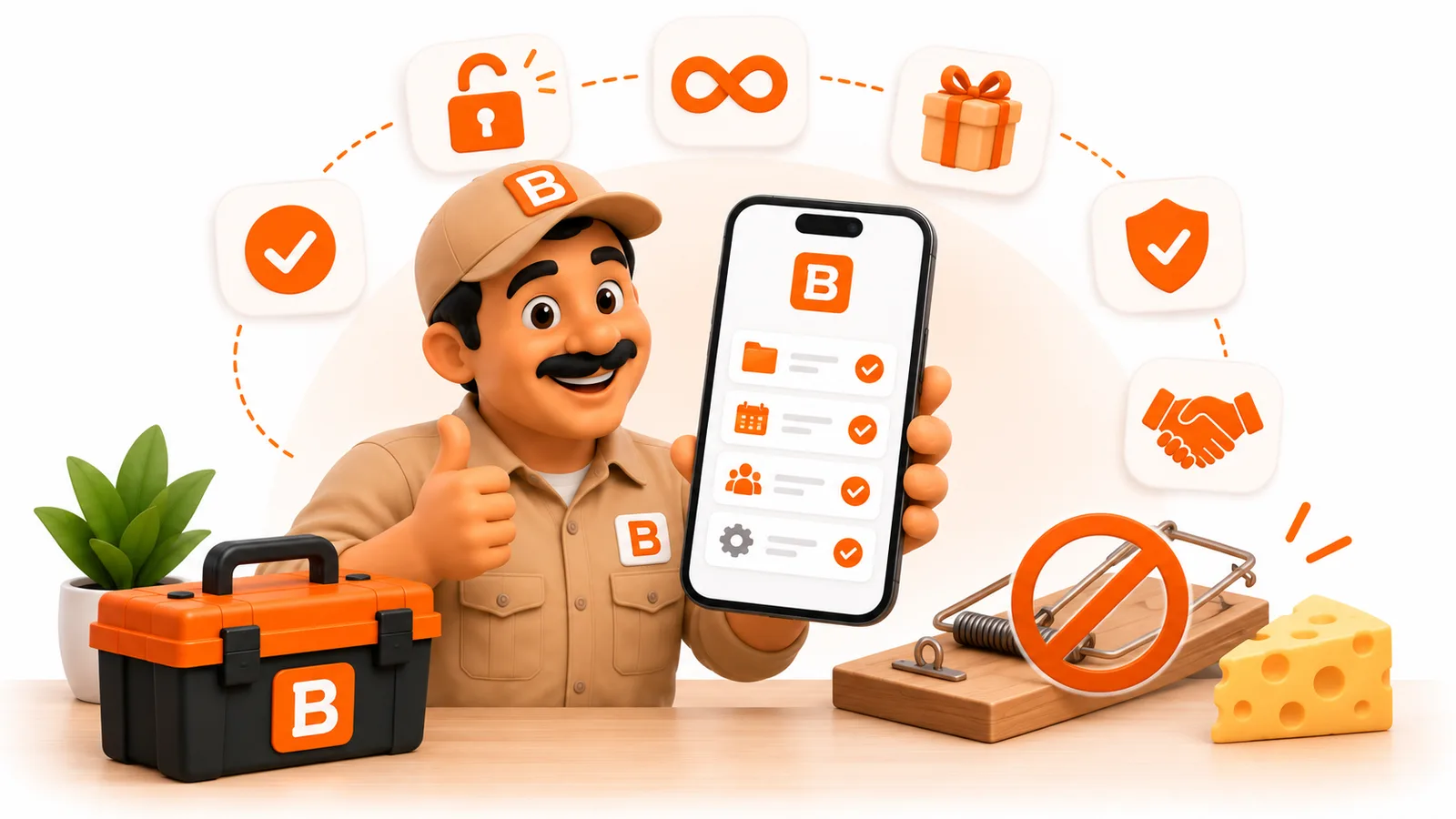
The free tier is not a mousetrap
Most free software in this industry is bait. The good stuff is visible but locked, the limits are tuned to pinch right when the tool starts being useful, and the whole thing is designed to make you want out of it.
I'm not building that. I'm not interested in putting a piece of cheese at the end of a trap and waiting for someone to come chase it.
The test I hold us to is whether a small operator can run their actual business on ToolBerry Free, indefinitely, and never feel like they're being squeezed toward a paid plan. Not a trial of the real product. The real product, for the people it was built for.
That means when we find a way to make something free, we do it, even when someone on our own team points out we could charge for it. That argument happens internally more than you'd think, and it usually ends the same way: if it doesn't cost us anything, I'm not going to invent a reason to bill you for it.
The test is 100,000 users, not the first 1,000
Here's the part that isn't obvious from the outside.
The first thousand users of almost any feature are free. A thousand people barely register on any bill. If I only looked at what a feature costs today, I'd give everything away and mean it sincerely.
The problem is what happens at a hundred thousand. A feature that costs a fraction of a cent per user is a rounding error at launch and a five-figure monthly invoice at scale. Server-side sync is the clearest example: nobody notices the first thousand accounts syncing, and at real volume it's an infrastructure bill that could take the whole company down.
So I don't ask what a feature costs now. I ask what it costs when ToolBerry is much bigger than it is today, and decide against that number. That's why some genuinely useful things sit in Pro even though we could hand them out cheaply right now.
It feels stingy in the moment. It's the only way the promise survives contact with growth.
Because taking it back later is the real betrayal
This is the part I care about most.
The industry is full of free tiers that existed until the math caught up with them. Heroku ran one of the most loved free tiers in tech for over a decade and removed it entirely in November 2022. Closer to home, Workiz offered a free plan for years and no longer lists one.
I don't say that to score a point. Those decisions are usually forced, not cynical: the free tier genuinely started costing more than it returned, and someone had to stop the bleeding. That's what makes it a cautionary tale rather than a villain story.
But put yourself on the other end of it. You moved your customer list, your schedule, and three years of job history into something because it was free. You built your week around it. Then you get an email saying the thing you depend on ends in sixty days.
I would rather never offer a feature for free than offer it and take it back. So when we can't find a way to make something sustainably free, we don't ship a generous version now and hope we figure it out later. We put it in Pro and say so plainly.
What the rule actually forces us to do
When something looks expensive, we get two options: charge for it, or engineer our way out of the cost. The rule means we're obligated to try the second one first, and that's where most of the interesting work in this product has come from.
File storage became your storage. Job photos at scale are a serious bill, and cost isn't even the worst part. Hosting files for anonymous users means hosting whatever anyone uploads, with all the privacy and abuse problems that brings. So we didn't host them. Your files go to your own cloud storage, which you already have and control. That one decision solved a cost problem, a privacy problem, and an abuse problem at once, and it's why your data stays yours. (Your Data, Your Dropbox covers the mechanics.)
Adding a teammate took months to figure out. Getting a second person into your workspace normally requires accounts, and accounts mean a server, and a server means the thing we were trying to avoid. The easy answer was to make it a paid feature. Instead I spent a long stretch working out how to do it without accounts, passwords, or anyone handing over credentials. I won't pretend that was quick or obvious - it wasn't, and for a while I genuinely thought it couldn't be done. It's the clearest example of what this rule costs us in engineering time, and why I think it's worth paying.
Maps get cheaper rather than paid. A mapping provider starts charging once you're past a certain number of users. It's a few dollars a month at first, which is nothing, and the question is only whether it stays proportional as we grow. My first instinct wasn't to move maps into Pro. It was to ask how we make the app need the provider less, by keeping what you actually use on your device instead of fetching it over and over. A field app that works offline needs that anyway. Sometimes the cheap answer and the right answer are the same answer.
What's in Pro, and the honest reason why
Every one of these is in Pro for a specific reason, and the reason is never "because people would pay for it."
- Real-time sync across a crew needs an always-on server coordinating between devices. That's a per-user infrastructure cost that grows with every customer, forever.
- QuickBooks and similar integrations cost money to run, but the bigger issue is accountability. Connecting to someone's accounting system is a powerful thing to hand out anonymously, and I'm not willing to do it without knowing who's on the other end.
- In-app payments mean handling card data under strict compliance rules and paying processors. There's no free version of that.
- Storing your files on our infrastructure is the thing we deliberately designed around, for the reasons above.
- Committed support with a real response time is people's hours. Hours cost money at any scale.
If you're on Free and none of that describes your business, then you don't need Pro, and I'd rather tell you that than sell you something you won't use.
The uncomfortable parts
Sometimes the answer really is no. We don't always find a clever way around a cost. When we don't, the feature goes to Pro, and "we couldn't figure out how to give this away" is the honest reason.
Pro is what keeps Free alive. We're a business, not a charity. The paid plan isn't subsidizing free users, because free users cost us close to nothing by design. But Pro is what funds the people who keep building both.
I'll get some of these calls wrong. Some features we put in Pro will turn out to be cheaper than I thought. When that happens, the right move is to move them down into Free - and we have. That direction is the one I'm comfortable with.
What I'm committing to
So that this is something you can hold me to, not just a nice sentiment:
- If it can run on your device at no real cost to us, it's free - no matter how valuable it would be to charge for.
- We won't take back what we've given. A feature that ships in Free stays in Free.
- We'd rather delay a free feature than launch one we'd have to claw back. If we can't make the economics work permanently, we won't fake it temporarily.
- Pro is only for things that genuinely cost money or require trust a device can't provide - never for holding basic functionality hostage.
- We'll tell you when you don't need to pay us. Including when another tool fits you better than ours does.
Why this matters to me
The people we build for are running real businesses out of trucks, with no back office and no software budget. They've been handed tools that wanted a credit card before they'd even demonstrate value, and then watched those tools get more expensive as they grew.
Giving them something genuinely free isn't a growth tactic. It's the reason the product exists in the form it does. Every architectural decision we've made - data on your device, no accounts, your own storage, works with no signal - traces back to wanting the free version to be real and wanting it to survive.
I'd rather do the hard engineering than send you a bill. That's the whole idea.
- Stasi Berry, Founder, ToolBerry
Have a question?
We're a small team of engineers, and this is something I think about more than almost anything else in the product. If you think we've drawn the line in the wrong place, tell me: contact@toolberry.net. That argument has changed my mind before.
Grab ToolBerry from the App Store or Google Play, or visit toolberry.net.
Free forever for solo operators. No account. No credit card. Works offline.
Further reading
- Is ToolBerry Really Free Forever? - the business model, in detail
- Free vs Pro: The ToolBerry Story, and What Each Plan Is For - where the line falls today
- Why ToolBerry Is Offline-First - the architecture that makes free possible
- Workiz Doesn't List a Free Plan Anymore - what happens when the math catches up