
Free vs Pro: The ToolBerry Story, and What Each Plan Is For
Why we started free, why Pro exists, and the line we promise to keep between them.
Updated July 13, 2026
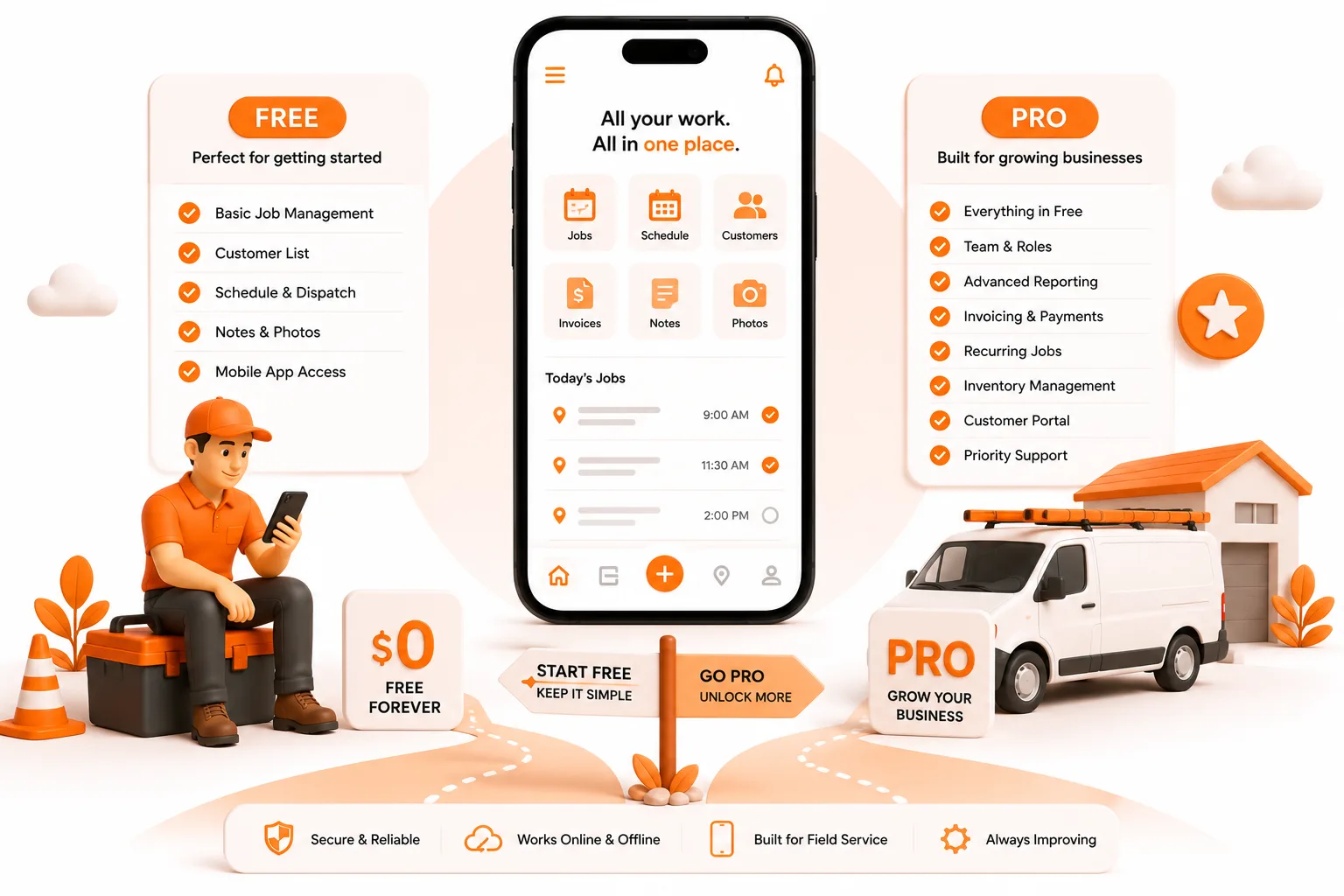
Why we started free, why Pro exists, and the line we promise to keep between them.
Published July 2026.
The short answer
ToolBerry Free is the whole app for a solo operator or small crew - records, scheduling, work orders, quotes and invoices, customization - running on your device, offline, free forever. ToolBerry Pro is for teams that have grown past what a shared Dropbox folder can do. It adds the capabilities that physically need a backend to exist: real-time sync across a crew, accounts with enforced roles and permissions, payments, and dispatch notifications, with online booking on the way.
Same product, same vision. Free is everything that can run on your device. Pro is the layer that can't. This is the story of why we drew that line, and the promise we're making about keeping it.
Where this started
ToolBerry began with a stubborn observation: the people who do the actual field work were the worst served by the software built for it. Solo operators and two-person crews - excellent at the trade, drowning in the admin around it - kept getting handed tools that wanted a credit card, an email, and a Wi-Fi signal before they'd even introduce themselves.
So we started from a different question: what would a field service app look like if it had to earn its place in the truck, with no signup form and no reliable signal? The answer had a chain of consequences. If you build the app offline-first, the solo user doesn't need a backend server. If there's no backend, there are no accounts. If there are no accounts, there's no signup wall. And if you need none of that, you can give the thing away - really away, free forever, not "free for 14 days."
That's not a marketing decision. It's an architectural one. Your data lives on your device in a real database, so a free ToolBerry user costs us almost nothing to run. "Free forever" is just what that architecture costs us, which is close to nothing. (The longer version is in Is ToolBerry Really Free Forever? and Why ToolBerry Is Offline-First.)
What Free is - and always will be
ToolBerry Free is not a trial or a teaser. It's the full product for the people it was built for: solo operators and small crews.
That means the whole core - customer, site, and job records; recurring and one-off scheduling; work orders with photos and notes; quotes and invoices generated from your job data; custom fields, statuses, and trade templates so it fits your work; iPhone, Android, and web; English and Spanish. No account, no email, no credit card, no timer. Open it and start.
The promise on Free is simple: anything that can run on your device, you get, and keep. We'll come back to why that promise is safe to make.
Why Pro had to exist
Here's the honest turn. Offline-first is a genuine superpower for one truck. But the day you become a real team - a few crews, an office, customers booking online, money moving through the app - you start needing things that a single device simply cannot do on its own.
Not "things we chose to put behind a paywall." Things that, as a matter of how software works, require a server sitting between people. That's the line Pro is built on. It isn't where we decided to start charging - it's where the device stops being enough.
The five things that genuinely need a backend
Each of these is a capability growing teams ask us for. Each one needs infrastructure a local-only app can't provide - and each is what ToolBerry Pro is built to add. Real-time sync, roles and permissions, payments and notifications are available today; online booking is still on the way.
Real-time sync across a team
ToolBerry Free already syncs - through Bring-Your-Own-Storage. Connect your own Dropbox and your data and customizations move between your devices and back up automatically, at no cost, with your files staying in your account. For one person across a phone, a tablet, and a laptop, or a small crew sharing one workspace by invite link, that's genuinely enough. (How it works is in Your Data, Your Dropbox.)
Where BYOS runs out of road is a real team. It syncs by moving files through your cloud folder, so it's periodic rather than instant, and it isn't built for several people editing the same jobs at the same moment. When two techs change the same work order at once, a file-based model has no neutral referee to merge them cleanly. Real-time, multi-writer sync - everyone seeing the same data update live, with conflicts resolved as they happen - needs a shared, always-on authority between devices. That's a coordinating server, and it's what ToolBerry Pro adds.
Accounts, roles, and permissions
"The office manager can edit prices; the tech in the field can't" only means something if it's enforced somewhere the user can't override. On your own device, you control everything - so roles can't truly be enforced locally. Real permissions need a server that holds identity and checks it on every action. It's a trust boundary, not a setting.
This one is live in Pro now, including custom roles - you define and name them to match your business instead of squeezing your crew into a fixed "Admin / User" list. (The full picture is in Who Can See What.)
Online booking
A customer booking from your website shows up from outside your business, at 9 p.m., while your phone is in your pocket. They need an always-on address to reach and a live view of your availability. An app sitting on your device isn't reachable by the public - taking bookings requires a server that's always up.
Payments
Taking a card means talking to a payment processor and handling card data under strict rules (PCI DSS). That has to run through a secure backend, not your phone - both to stay compliant and so the money actually moves. It's the clearest example of a feature that can't be "offline."
In-route and dispatch notifications
"Your tech is 10 minutes away," live arrival tracking, "new job assigned" alerts - these relay information between different people and fire push notifications, which only a server can broker (through Apple's and Google's push services) and keep flowing even when the app is closed.
The line we drew - and promise to keep
Put those together and the boundary is clean: Free is everything that can run on your device. Pro is the backend-powered layer for teams.
A few things follow from that, and they matter:
- Pro isn't subsidized by Free, and Free isn't subsidized by Pro. A free user costs us almost nothing, so there's nothing to subsidize. Pro customers pay for the infrastructure their bigger features actually use - nothing more.
- The value runs both ways. Anything we build that can run on your device without a server behind it ships to Free too. Free keeps getting better over time; it doesn't get hollowed out to push you toward Pro.
- You move to Pro when you genuinely need it and can afford it - when you hire, when customers start booking online, when you want to take payment in-app. Not to unlock the basics. The basics are never the thing behind the paywall.
How we keep this strategy as we grow
The easy version of this story ends with a company quietly gutting its free tier once the spreadsheet says to. We're trying to build the other kind. So here's what we're committing to, in writing:
- Free stays the full product for solo operators and small crews - not a trial, not a teaser, not a countdown.
- If a feature can run on your device, it belongs to Free - Pro or no Pro.
- Pro is only ever for capabilities that truly need a backend - never for holding the basics hostage.
- Your data stays yours - on your device on Free, and portable on Pro. You can always leave with it.
- We'll tell you when you don't need Pro yet. If Free covers you, we'd rather say so than sell you a plan you won't use.
That's the vision: grow with the operator, from one truck to a real fleet, without ever making the free version worse to make the paid version look better.
What this means for you
If you're a solo operator or small crew: nothing changes. Free is your whole tool, forever. Pro is there if you grow into it, not something we'll nudge you toward.
If you're a growing crew: run on Free until a real need shows up - a second office, live sync, in-app payments, enforced roles for your team. That's the moment Pro is built for.
If you're a midsize service business: Pro is the plan built for you, and the backend layer above is exactly its territory. Real-time sync, custom roles and permissions, payments and notifications are available now, with online booking on the way. Contact us and we'll tell you what fits your business.
Have a question?
We build ToolBerry as working engineers, and we're happy to talk through where the line between Free and Pro falls for your business. Reach us at contact@toolberry.net.
Grab ToolBerry Free from the App Store or Google Play, or visit toolberry.net.
Free forever for solo operators and small crews. Pro for teams that outgrow a shared Dropbox folder.
For the Technically Curious
The split between Free and Pro maps almost exactly onto a real line in software architecture: what a device can do alone, versus what needs a coordinating server.
A local-first app treats your device as the source of truth. Reads and writes hit an on-device database first, instantly, with no network in the path - which is what makes ToolBerry fast and fully functional offline. That model covers the entire product for one operator or a small crew. It breaks down only when correctness depends on more than one party agreeing:
- Sync is a consistency problem. Bring-Your-Own-Storage covers one operator or a small crew by shuttling files through your own cloud, but multiple simultaneous writers need conflict resolution against a shared, always-available authority - which devices syncing through a personal file store can't provide.
- Roles and permissions are a trust problem. Enforcement has to live outside the device the user controls, or it isn't enforcement.
- Booking and notifications are a reachability problem. The public, and your other crew members, need an always-on endpoint to reach - and push delivery runs through APNs and FCM, which are server-to-device channels.
- Payments are a compliance problem. Card data and processor connections have to sit behind a PCI-compliant backend.
So Pro isn't a rewrite or a different app - it's the same local-first core with a sync-and-services backend layered on top, added only for the users who need it. Free users never touch that backend, which is exactly why Free can stay free. If you want the deeper architecture story, it's in Why ToolBerry Is Offline-First.
Further reading
- Is ToolBerry Really Free Forever? - the business model behind Free
- Why ToolBerry Is Offline-First - the architecture that makes Free possible and Pro necessary
- What Every Field Service App Actually Needs (and What's Just Bloat) - core versus everything else
- The Best Free Field Service Apps in 2026: An Honest Comparison - where ToolBerry Free fits